Sneha had lost nearly twelve kilograms.
She had changed her diet, started walking every morning and remained consistent for more than a year. Her clothes fit better, she felt healthier and the number on the weighing scale had gradually come down.
But one area around her lower abdomen seemed unwilling to change.
She began wondering whether liposuction could help her lose the remaining weight.
During her consultation, she learned an important distinction:
Weight loss and body contouring are not the same thing.
Liposuction may help reshape selected areas containing stubborn fat, but it is not a shortcut for significant weight loss. Knowing what the procedure can—and cannot—accomplish is essential before considering it.
What Exactly Is Liposuction?
Liposuction is a surgical body-contouring procedure that removes selected fat deposits from specific areas of the body.
It may be performed on areas such as the:
- Abdomen
- Waist
- Hips
- Thighs
- Upper arms
- Back
- Chest
- Chin and neck
- Knees
The purpose is to improve proportion and contour—not to reduce overall body weight dramatically.
A surgeon uses a thin instrument called a cannula to remove planned amounts of fat through small incisions. The technique and extent of treatment depend on the area, skin quality, amount of fat and the patient’s individual anatomy.
Liposuction and Weight Loss Are Not the Same
When a person loses weight through nutrition and physical activity, fat cells throughout the body generally become smaller.
Liposuction works differently. It physically removes a selected number of fat cells from a specific treatment area.
| Weight loss | Liposuction |
| Affects the body more generally | Targets selected areas |
| Primarily reduces the size of fat cells | Removes some fat cells |
| Achieved through calorie balance and lifestyle changes | Performed as a surgical procedure |
| Improves health when excess weight is reduced appropriately | Primarily improves body contour |
| May produce a significant change on the weighing scale | Usually produces a limited change in weight |
This is why liposuction should not be viewed as a treatment for obesity.
Its value lies in reshaping areas that remain disproportionate despite reasonable lifestyle efforts.
What Is “Stubborn Fat”?
Some areas of fat can be influenced by genetics, hormones, age and individual fat-distribution patterns.
Two people with similar body weights may store fat in very different areas. One may notice greater fullness around the abdomen, while another may carry more fat around the hips or thighs.
These localized deposits may remain even after overall weight reduction.
However, the phrase “stubborn fat” should not be used to suggest that every unwanted area requires surgery. A clinical assessment is necessary to understand whether the concern involves:
- Localized fat
- Loose skin
- Weak or separated abdominal muscles
- Generalized excess weight
- Bloating or another medical concern
- A combination of different factors
Liposuction primarily addresses fat. It does not correct every cause of body-shape dissatisfaction.
Who May Be a Suitable Candidate?
A person may be considered for liposuction when they:
- Are near a stable and appropriate body weight
- Have localized fat deposits
- Maintain generally healthy lifestyle habits
- Are in suitable health for surgery
- Have reasonably good skin elasticity
- Understand that the procedure is for contouring
- Have realistic expectations
- Are willing to follow recovery instructions
Suitability cannot be determined from body weight or photographs alone. The surgeon must consider overall health, skin tone, fat distribution and treatment goals.
Who May Not Be an Ideal Candidate?
Liposuction may not be appropriate when:
- The primary goal is significant weight loss
- Body weight is still changing considerably
- The main concern is loose or hanging skin
- There are untreated health conditions that increase surgical risk
- The individual expects an entirely different body shape
- The procedure is being considered as a replacement for exercise and balanced nutrition
- Skin elasticity is unlikely to support the expected contour
Sometimes, delaying surgery until body weight becomes stable can produce a more predictable result.
Can Liposuction Tighten Loose Skin?
Liposuction removes fat, but it does not automatically remove substantial loose skin.
After fat is removed, the skin needs to adapt to the new contour. How well it does so depends on:
- Age
- Genetics
- Skin elasticity
- The treatment area
- Previous pregnancy
- Previous weight changes
- The amount of fat removed
- Existing stretch marks or skin damage
If the main concern is loose abdominal skin or weakened muscles—particularly after pregnancy or major weight loss—abdominoplasty may be more appropriate than liposuction alone.
In selected cases, liposuction and abdominoplasty may be combined. The correct approach depends on individual examination.
Liposuction Versus Tummy Tuck
These procedures are frequently confused, but they address different concerns.
| Liposuction | Abdominoplasty |
| Removes localized fat | Removes excess abdominal skin |
| Uses relatively small incisions | Requires a longer abdominal incision |
| Does not directly repair separated muscles | May include muscle repair when appropriate |
| Best suited to selected contour concerns | Considered when loose skin or abdominal-wall changes are present |
| Cannot substitute for substantial skin removal | May be combined with liposuction for selected patients |
One procedure is not automatically better than the other. The right option depends on what is creating the unwanted contour.
What Happens During Liposuction?
The exact process varies according to the number and size of the treatment areas.
Generally, the procedure involves:
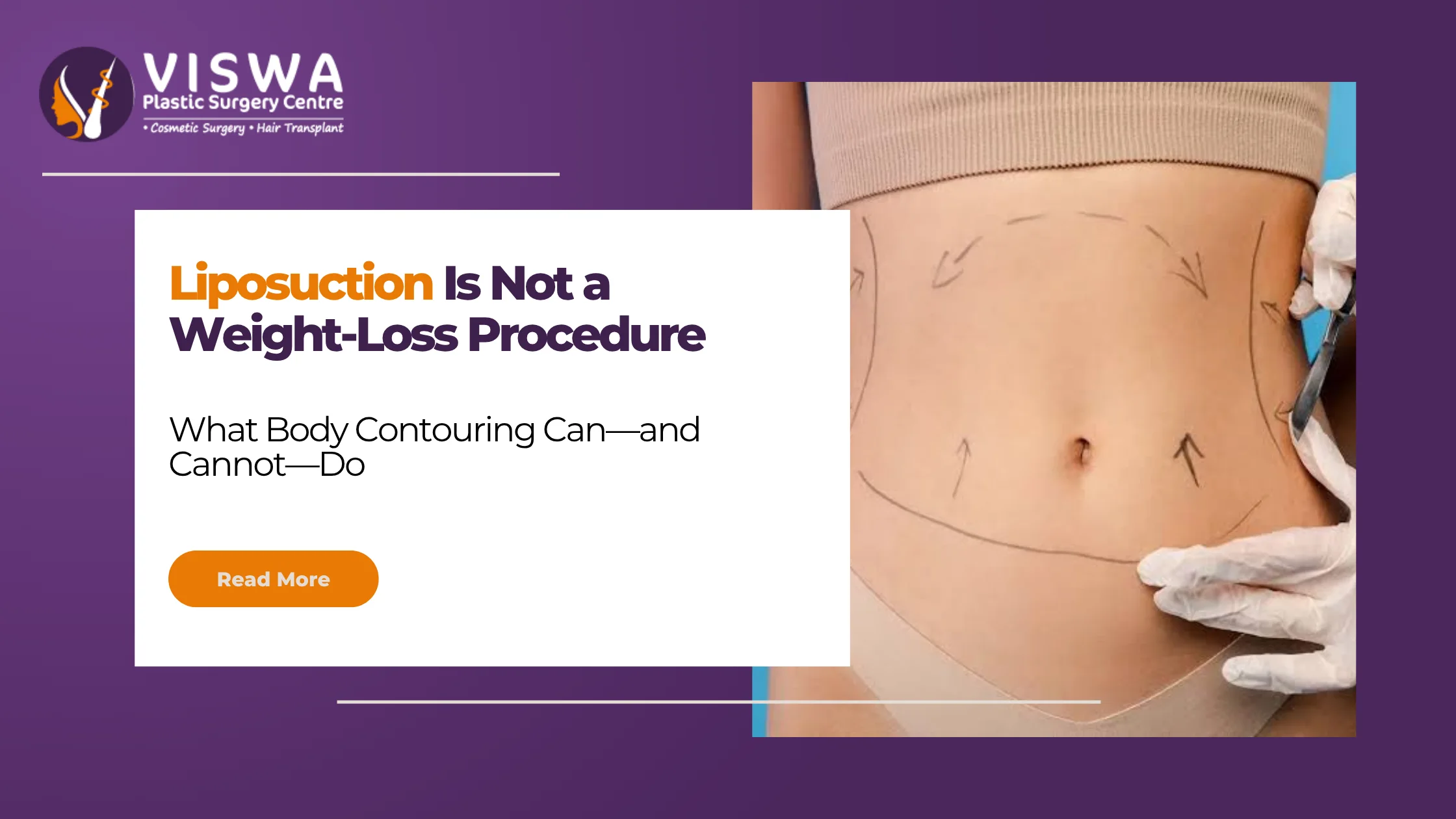
- Marking the planned treatment areas
- Administering the appropriate form of anaesthesia
- Making small, carefully positioned incisions
- Inserting a cannula to loosen and remove selected fat
- Checking contour and symmetry
- Applying dressings or a compression garment
The surgeon aims to create a smoother transition between the treated and untreated areas.
Removing the maximum possible amount of fat is not the objective. Excessive removal can increase risks and produce uneven contours.
What Is Recovery Like?
Recovery depends on the treatment area and the extent of the procedure.
Patients may experience:
- Swelling
- Bruising
- Temporary soreness
- A feeling of tightness
- Fluid drainage from small incision sites
- Temporary numbness
- Use of a compression garment
- Restrictions on strenuous activity
Light walking is often encouraged according to medical advice. It can support circulation and help patients gradually return to their routine.
Although some improvement may become noticeable as early swelling settles, the contour continues to develop over time. Final results should not be judged during the initial recovery period.
Can Fat Return After Liposuction?
The fat cells removed during liposuction do not regenerate in the same way.
However, liposuction does not prevent future weight gain.
The remaining fat cells can enlarge if a person gains weight. Significant weight changes may affect both treated and untreated areas and alter the result.
Maintaining a stable weight through sustainable habits is therefore important for preserving the contour.
Liposuction should complement a healthy lifestyle—not replace one.
Does Liposuction Remove Cellulite?
Not reliably.
Cellulite involves the relationship between fat, skin and the fibrous bands beneath the skin. Because liposuction primarily removes deeper fat, it is not considered a dependable treatment for cellulite.
In some individuals, changes in volume may alter its appearance, but improvement cannot be guaranteed. Inappropriate or overly aggressive fat removal may sometimes make surface irregularities more noticeable.
Patients should discuss cellulite separately during consultation.
Common Myths About Liposuction
Myth 1: Liposuction Helps You Lose a Large Amount of Weight
False.
Liposuction is intended for body contouring, not major weight reduction.
Myth 2: The Procedure Can Replace Exercise
No.
Exercise remains important for cardiovascular health, strength, weight management and long-term well-being.
Myth 3: Liposuction Permanently Prevents Weight Gain
False.
A person can still gain weight after the procedure.
Myth 4: Liposuction Automatically Tightens Loose Skin
Not necessarily.
Skin contraction depends on elasticity and other individual factors. Significant loose skin may require a different procedure.
Myth 5: More Fat Removal Means a Better Result
False.
Safe, measured fat removal and smooth contouring are more important than removing the largest possible volume.
Myth 6: Liposuction Results Are Immediate
No.
Post-operative swelling temporarily affects the contour. The result becomes clearer as healing progresses.
Questions to Ask During Consultation
Before deciding on liposuction, ask:
- Is my concern caused by fat, skin or muscle changes?
- Am I close enough to a stable weight?
- Is my skin likely to adapt after fat removal?
- Which areas can be treated safely?
- How much improvement is realistic?
- Would another procedure be more suitable?
- What type of anaesthesia may be used?
- How long will I need to wear a compression garment?
- When can I return to work and exercise?
- What risks or contour irregularities should I understand?
A good consultation should help you understand whether liposuction matches your actual concern—not simply confirm that you can undergo the procedure.
Conclusion
Liposuction can be useful when a person is generally close to a stable weight but remains concerned about localized fat that affects body proportion.
What it cannot do is replace healthy weight management, remove substantial loose skin or guarantee a particular body shape.
The best results usually begin with the right diagnosis of the contour concern. Is the problem primarily excess fat? Loose skin? Muscle separation? General weight gain? Or a combination?
Once that is understood, the most suitable treatment—or the decision not to undergo surgery—becomes much clearer.
For individuals in Guntur, Amaravathi, Tenali, Mangalagiri, Sattenapalli, Chilakaluripet, Narasaraopet and nearby areas, consulting a qualified plastic surgeon can help determine whether liposuction or another body-contouring approach is appropriate for their individual anatomy and goals.
FAQs
How much weight can I lose through liposuction?
Liposuction is not designed for significant weight loss. The amount of fat removed is determined by safety, anatomy and contouring requirements.
Is liposuction permanent?
The removed fat cells do not return in the same way, but future weight gain can enlarge the remaining fat cells and change the result.
Can liposuction remove belly fat?
It may remove selected subcutaneous fat beneath the skin. It cannot remove visceral fat located around the internal organs.
Will my skin become loose after liposuction?
The outcome depends on skin elasticity and the amount of fat removed. Patients with significant existing skin laxity may require a different procedure.
Is liposuction suitable after pregnancy?
It may be considered once pregnancy-related changes have stabilized. Some patients may need treatment for loose skin or separated abdominal muscles rather than liposuction alone.
How soon can I exercise after the procedure?
Return to exercise is gradual and depends on the treated areas and extent of surgery. Follow the surgeon’s specific instructions.
Does liposuction remove stretch marks?
No. Liposuction removes fat and does not directly eliminate stretch marks.
Can liposuction and tummy tuck be performed together?
They may be combined in selected patients when medically appropriate. This depends on health, anatomy and the surgeon’s assessment.